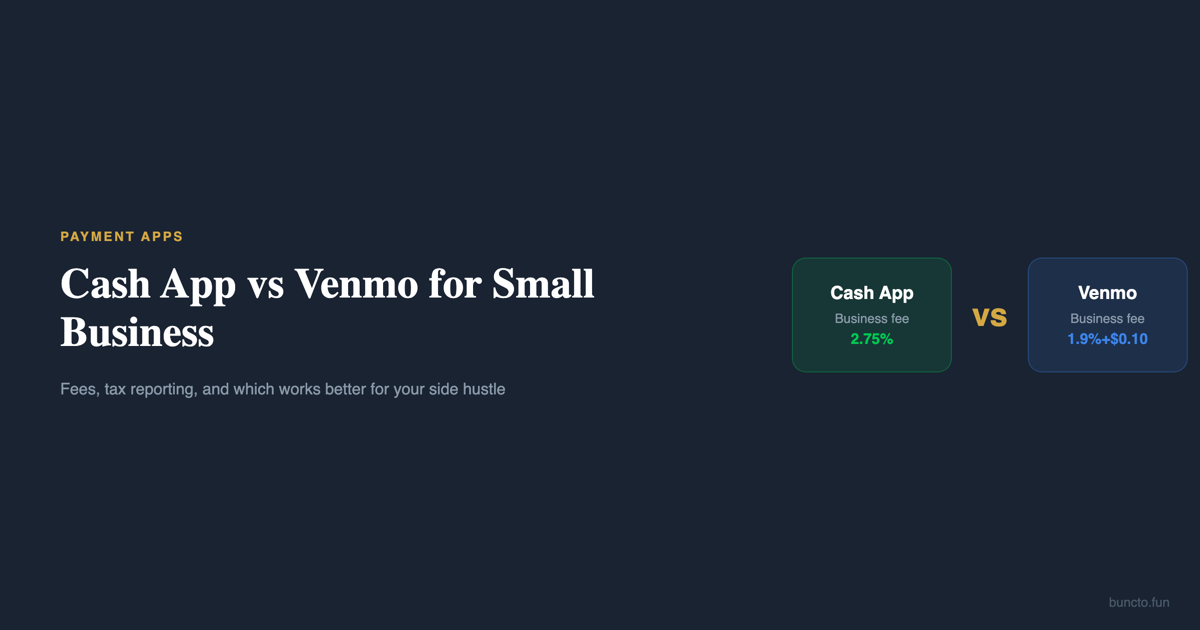
Quick answer: Cash App for Business charges a 2.75% fee per payment received, while Venmo for Business charges 1.9% plus -bash.10 per transaction. Both report income to the IRS when you exceed the 1099-K threshold. For most small businesses, Venmo is cheaper per transaction and offers purchase protection for buyers, but Cash App has simpler onboarding and faster deposits. The right choice depends on your transaction volume and whether your customers already use one platform.
In this article
- What Is the Difference Between a Cash App Business Account and a Venmo Business Profile?
- Which Platform Has Lower Fees for Small Businesses?
- How Does Tax Reporting Work on Each Platform?
- Which Platform Offers Better Buyer Protection?
- Which Gets Money to Your Bank Account Faster?
- Which Should a Small Business Actually Choose?
- Sources
What Is the Difference Between a Cash App Business Account and a Venmo Business Profile?
Cash App for Business is a separate account type within the Cash App ecosystem. When you enable it, incoming payments are flagged as business income and a 2.75% processing fee applies to every payment received. Personal Cash App accounts do not charge receiving fees. The business account gets a dedicated , the ability to accept payments from anyone, and automatic tax document generation.
Venmo for Business works through a business profile layered on top of your personal Venmo account. The fee is 1.9% plus -bash.10 per transaction for payments received through your business profile. According to the Venmo User Agreement, Venmo purchase protection covers goods and services transactions but not personal payments. This is a significant advantage — buyers who pay your business profile get Venmo Purchase Protection, which gives them confidence to buy.
Neither platform is a full payment processor like Square or Stripe. They are peer-to-peer apps with business features bolted on. That distinction matters for tax reporting, disputes, and transaction limits. For understanding payment app safety more broadly, see our Venmo safety guide.
Which Platform Has Lower Fees for Small Businesses?
Venmo wins on per-transaction cost for almost every scenario. At 1.9% + -bash.10, a 0 payment costs you .05 on Venmo vs. .38 on Cash App. The gap widens with higher transaction amounts: a 00 payment costs .90 on Venmo vs. .50 on Cash App.
| Transaction Amount | Cash App Fee (2.75%) | Venmo Fee (1.9% + -bash.10) | Savings With Venmo |
|---|---|---|---|
| 5 | -bash.69 | -bash.58 | -bash.11 |
| 0 | .38 | .05 | -bash.33 |
| 00 | .75 | .00 | -bash.75 |
| 00 | .50 | .90 | .60 |
| 00 | 3.75 | .60 | .15 |
The only scenario where Cash App costs less is when the fixed -bash.10 Venmo fee matters more than the rate difference — transactions under roughly 2. For most small businesses processing payments above that threshold, Venmo’s rate structure is more favorable. I consider this the decisive factor for cost-conscious sole proprietors. Check our research methodology for how we compare fintech products.
How Does Tax Reporting Work on Each Platform?
Both platforms are required to report business income to the IRS. When your business account receives more than 00 in a calendar year, the platform issues a 1099-K form. This threshold dropped from 0,000 and 200 transactions after the American Rescue Plan Act, though the IRS has phased in enforcement gradually.
Cash App sends the 1099-K through the app and by mail. Venmo does the same for business profile transactions. Personal transfers between friends are not reported, which is why using a business profile or business account matters — it separates taxable income from personal reimbursements.
Keep your business and personal transactions separate. If you receive business payments on a personal account, you still owe taxes on that income, but the platform may not generate the 1099-K, creating a documentation gap that complicates filing. Both platforms let you download transaction histories for your records.
Which Platform Offers Better Buyer Protection?
Venmo has a clear advantage here. Venmo purchase protection covers goods and services transactions, according to the Venmo User Agreement. When a customer pays through your Venmo business profile and the transaction is marked as goods or services, the buyer is protected if the item never arrives or is significantly different from what was described.
Cash App offers no equivalent buyer protection for business transactions. If a customer pays your Cash App business account and disputes the charge, Cash App may investigate, but there is no formal purchase protection program. This means your customers take on more risk when paying via Cash App.
For a service-based business — a freelance designer, a personal trainer, a mobile mechanic — this difference matters less because the service is delivered in person. For anyone selling physical goods, Venmo’s buyer protection removes friction from the purchase decision. Relatedly, understanding how payment disputes work helps you set customer expectations.
Which Gets Money to Your Bank Account Faster?
Both platforms offer standard and instant deposit options. Standard deposits are free and arrive in 1 to 3 business days on both platforms. Instant deposits cost a fee: Cash App charges 0.5% to 1.75% (minimum -bash.25) for instant deposits, while Venmo charges 1.75% (minimum -bash.25, maximum 5).
Cash App has a slight edge on standard deposit speed in practice. Many users report next-business-day arrivals for standard Cash App deposits, while Venmo standard deposits more consistently take the full 1 to 3 days. Neither platform guarantees same-day for free deposits.
If cash flow timing matters to your business, factor the instant deposit fee into your cost comparison. A freelancer receiving a 00 payment and needing instant access would pay .75 to .75 on Cash App or .75 on Venmo for the instant deposit alone — on top of the business transaction fee.
Which Should a Small Business Actually Choose?
Choose Venmo if your customers already use Venmo, if you sell physical goods, or if transaction fees are your primary concern. The lower rate, buyer protection, and social feed visibility give Venmo an edge for consumer-facing small businesses.
Choose Cash App if you need the simplest possible setup, if your customers skew toward Cash App’s user base, or if you primarily provide services where buyer protection is less relevant. Cash App’s onboarding is faster — you can start accepting business payments within minutes.
Neither replaces a proper payment processor for businesses doing significant volume. Once you consistently exceed ,000 per month in transactions, platforms like Square (which owns Cash App) or Stripe offer lower rates, better reporting, and proper invoicing tools. These peer-to-peer apps are best for solo operators, side businesses, and small-ticket transactions under a few hundred dollars. For broader financial planning, see our guide on budgeting apps for freelancers.
Sources
- Venmo User Agreement — business profile fees and purchase protection terms
- Cash App Terms of Service — business account fees and deposit policies
- IRS Form 1099-K guidance — reporting thresholds and requirements
- Consumer Financial Protection Bureau — peer-to-peer payment regulation