About 26 million Americans are “credit invisible” — they have no credit file at any of the three major bureaus — according to the Consumer Financial Protection Bureau. Another 19 million have files too thin to produce a score. If you have never had a loan, credit card, or utility account reported in your name, you start with no score at all, not a zero. Building credit from scratch is a defined process with a predictable timeline, not a mystery. This guide covers every viable method, the realistic timeline for each, and the fintech tools that make it cheaper than it used to be. For how we verify these product details, see our research methodology.
In this article
- How does credit scoring actually work when you start with nothing?
- What is a realistic timeline for building credit from zero?
- What are the best methods for building credit when you have none?
- Which fintech credit-building tools are worth the cost?
- What mistakes can set back your credit-building progress?
- Frequently Asked Questions
How does credit scoring actually work when you start with nothing?
You do not start with a credit score of zero. You start with no score at all, because the scoring models need a minimum amount of data to produce one. FICO requires at least one account that has been open for six months and at least one account reported to the bureau in the last six months. VantageScore can generate a score with as little as one month of history and one account.
FICO scores range from 300 to 850. The five factors are payment history (35%), amounts owed (30%), length of credit history (15%), credit mix (10%), and new credit inquiries (10%). For someone building from scratch, only two of those factors matter initially: payment history and amounts owed. The other three require time and multiple account types to influence your score meaningfully.
The practical takeaway: open one account that reports to at least one bureau, make every payment on time, keep the balance low relative to the limit, and wait. Six months produces a FICO score. Twelve months produces a useful one.
What is a realistic timeline for building credit from zero?
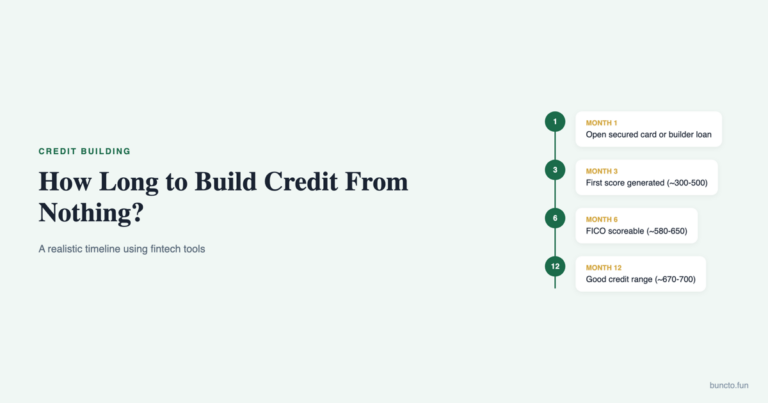
Expect your first scoreable FICO file at 6 months, a fair score (580-669) by month 8-10, and a good score (670-739) by month 14-18 if every payment is on time and utilization stays below 30%.
| Milestone | Timeline | What Triggers It |
|---|---|---|
| First VantageScore generated | 1-2 months | One account reported with one month of activity |
| First FICO score generated | 6 months | One account open 6+ months, reported in last 6 months |
| Score reaches 580-620 (fair) | 6-10 months | Consistent on-time payments, low utilization |
| Score reaches 670+ (good) | 12-18 months | Longer history, mixed account types, zero missed payments |
| Score reaches 740+ (excellent) | 24-36+ months | Multiple accounts, aging history, perfect payment record |
These are median timelines based on starting with zero history. If you become an authorized user on a well-established account, the timeline accelerates because you inherit that account’s age and payment history.
What are the best methods for building credit when you have none?
The five proven methods are secured credit cards, credit builder loans, authorized user status, rent reporting, and secured installment loans. Each has different costs, speed, and bureau coverage.
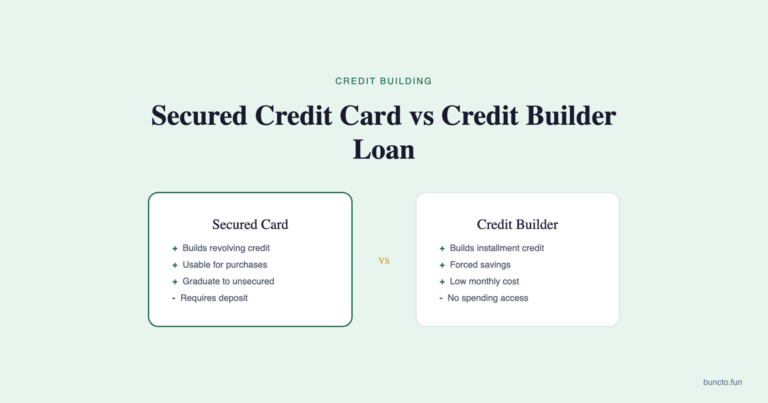
Secured credit cards require a refundable deposit, typically 00-00, which becomes your credit limit. You use the card for small purchases and pay the balance in full each month. The issuer reports to all three bureaus. Discover it Secured and Capital One Platinum Secured are the two strongest options because both report to Equifax, Experian, and TransUnion, and both offer paths to upgrade to unsecured cards without closing the account. For a head-to-head comparison with credit builder loans, read our detailed breakdown.
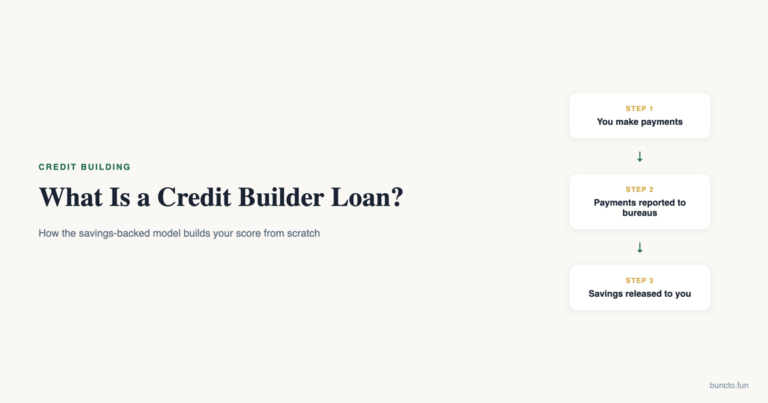
Credit builder loans work in reverse. You make monthly payments into a locked savings account, and the lender reports those payments to the bureaus. When the loan term ends, you receive the funds. Self (formerly Self Lender) is the most popular, with plans starting at 5/month. MoneyLion and SeedFi also offer credit builder products with varying terms and bureau reporting.
Authorized user status is the fastest method. When someone with good credit adds you as an authorized user on their credit card, their account history appears on your credit report. You do not need to use the card. This works best when the primary cardholder has a long history with low utilization. Not all issuers report authorized users to all bureaus — verify before proceeding.
Rent reporting services like Boom, RentTrack, and Piñata report your monthly rent payments to one or more bureaus. The cost is typically -0 per month. The impact is real but slower than a credit card or loan, and some scoring models weight rent payments less heavily.
Secured installment loans add a different account type to your file, which helps with credit mix. But they are expensive relative to their benefit for someone just starting out. I recommend them only after you already have a revolving account established.
Which fintech credit-building tools are worth the cost?
Self and Chime Credit Builder are the two most effective fintech tools for building credit from scratch, based on cost, bureau coverage, and user outcomes.
| Tool | Type | Monthly Cost | Reports To | Deposit Required | Best For |
|---|---|---|---|---|---|
| Self | Credit builder loan | 5-50 | All 3 bureaus | None (payments build the balance) | People with no existing accounts |
| Chime Credit Builder | Secured charge card | -bash | All 3 bureaus | Move money from Chime checking | Existing Chime users |
| Grow Credit | Subscription reporting | -bash-.99 | All 3 bureaus | None | People who want to build credit through subscription payments |
| MoneyLion Credit Builder | Credit builder loan | -bash (membership may apply) | All 3 bureaus | None | MoneyLion members |
| Discover it Secured | Secured credit card | -bash (deposit 00+) | All 3 bureaus | 00 minimum refundable deposit | People who can put up a deposit and want cash-back rewards |
Chime Credit Builder is the lowest-cost option if you already have a Chime checking account. You move funds from your checking to the Credit Builder balance, spend against it, and Chime reports the payments. There is no hard credit check, no interest, and no fees. The limitation is that it requires a Chime account with direct deposit.
Self is the best option if you have no existing accounts at all. The application does not require a bank account, and the monthly payments are predictable. The downside is that you pay interest on the loan (around 15% APR depending on the plan), so you are paying for the credit-building service, not getting free money.
What mistakes can set back your credit-building progress?
The three costliest mistakes are missing a payment, maxing out your secured card, and applying for too many accounts at once. Each one is avoidable, and each one can erase months of progress.
A single missed payment stays on your credit report for seven years. With a thin file, one late payment can drop your score by 50-80 points. Set up autopay for at least the minimum payment on every account. Manual payments add unnecessary risk.
Utilization — the percentage of your credit limit that you are using — should stay below 30%, and ideally below 10%. On a 00 secured card, that means keeping your balance under 0 at the statement closing date, and ideally under 0. High utilization signals risk to scoring models, even if you pay in full each month.
Each application for credit triggers a hard inquiry, which costs 5-10 points and stays on your report for two years. When you are building from scratch, apply for one account, wait six months, then consider a second. Applying for three cards in a month is a common mistake that damages a new file.
If you are building credit as an immigrant or new to the US banking system, the process has additional steps. Read our guide on building credit without a Social Security number for the specific requirements and tools available.
Frequently Asked Questions
Standard debit cards do not build credit because banks do not report debit activity to credit bureaus. However, some fintech products like Extra and Cleo now offer debit-linked credit building where they report transactions as credit activity. These are newer products with less track record than secured cards.
You do not start with any score. Many people believe the starting score is 300, but this is incorrect. You have no score until at least one account has been reported to a bureau for a minimum period. FICO requires six months of history. VantageScore needs one month.
Paying weekly keeps your utilization lower at the statement closing date, which can improve your score. But the minimum effective strategy is paying the full balance before the due date each month. Weekly payments are a refinement, not a requirement. Start with monthly autopay.
One account is enough to generate a score. Two accounts — one revolving (credit card) and one installment (loan) — improve your credit mix, which accounts for 10% of your FICO score. You do not need more than three accounts in your first two years.
No. Checking your own score through your bank, Credit Karma, or a bureau directly is a soft inquiry and has zero impact on your score. Only applications for new credit (hard inquiries) affect your score, and even those are minor (5-10 points each).
Sources
- CFPB — Data Point: Credit Invisibles
- FICO — What’s in Your Credit Score
- Self — Credit Builder Loan Terms (accessed Aug 2026)
- Chime — Credit Builder Product Details (accessed Aug 2026)
- Discover — Secured Credit Card Terms (accessed Aug 2026)
- Experian — Credit Score Basics