The average savings account at a brick-and-mortar bank pays 0.46% APY, according to the FDIC’s national rate data. At that rate, 0,000 earns 6 per year. The same 0,000 in a high yield savings account at 4.50% APY earns 50. The difference is real money, and switching takes about ten minutes. But most HYSA marketing obscures how the yield works, what happens when rates change, and when a CD or money market account is the better choice. This guide covers the mechanics, not just the rates. For our fact-checking process, see the research methodology.
In this article
- How does a high yield savings account actually work?
- Where does the high yield come from, and why does it change?
- Which high yield savings accounts are worth opening?
- Should you chase the highest HYSA rate or pick one and stay?
- When should you choose a CD or money market account instead?
- How are HYSA earnings taxed?
- Frequently Asked Questions
How does a high yield savings account actually work?
A high yield savings account works identically to a regular savings account — deposits, withdrawals, FDIC insurance — except it pays a significantly higher interest rate because the bank operates online with lower costs. Online banks do not maintain physical branches, which eliminates real estate, staffing, and operational expenses. Those savings fund the higher APY offered to depositors.
The interest compounds daily at most HYSAs, credited monthly. On a 4.50% APY balance of 0,000, daily compounding earns approximately 60 per year versus 50 with monthly compounding. The difference is small but it does exist. APY (annual percentage yield) already accounts for compounding frequency, so the advertised rate is what you actually earn.
HYSAs are covered by FDIC insurance up to 50,000 per depositor, per bank. If the bank fails, you get your money back up to that limit. This is the same protection as any other bank deposit product. Some institutions, like Wealthfront, offer extended coverage by sweeping deposits across multiple partner banks — effectively raising the insured limit.
Where does the high yield come from, and why does it change?
HYSA rates track the federal funds rate set by the Federal Reserve. When the Fed raises rates, HYSAs pay more. When the Fed cuts, HYSAs pay less. This is because banks lend deposited funds in the interbank market at rates pegged to the federal funds rate. The APY they offer depositors is a spread below that market rate.
Between March 2022 and July 2023, the Fed raised rates from 0.25% to 5.50%. HYSA rates followed, climbing from around 0.50% to over 5.00%. As of when I last checked, the federal funds rate sits at 5.25%-5.50%, and top HYSAs pay 4.50%-5.00%. If the Fed cuts rates by 0.50%, expect HYSA rates to decline by a similar amount within a few weeks.
Banks are not required to pass rate changes through immediately. Some drop rates faster than others. Marcus by Goldman Sachs, for example, historically adjusts rates within days of a Fed decision. Smaller online banks sometimes lag by 2-4 weeks. This is why chasing the absolute highest rate is less productive than picking a consistently competitive bank.
Which high yield savings accounts are worth opening?
The strongest HYSAs combine competitive rates with no fees, no minimum balance, and reliable rate-tracking when the Fed moves. I evaluated accounts based on current APY, fee structure, minimum balance requirements, FDIC coverage, withdrawal flexibility, and how quickly the bank adjusts rates after Fed decisions.
| Bank | Current APY | Monthly Fee | Minimum Balance | FDIC Insured | Withdrawal Method | Rate Adjustment Speed |
|---|---|---|---|---|---|---|
| Marcus by Goldman Sachs | 4.40% | -bash | -bash | Yes (direct) | ACH transfer (1-3 days) | Fast (days) |
| Ally Bank | 4.20% | -bash | -bash | Yes (direct) | ACH, same-day option | Moderate (1-2 weeks) |
| SoFi | 3.80% | -bash | -bash | Yes (direct charter) | Instant to SoFi checking | Moderate |
| Wealthfront | 4.50% | -bash | -bash | Yes (up to M via partners) | ACH transfer (1-3 days) | Fast (days) |
| Discover | 4.25% | -bash | -bash | Yes (direct) | ACH transfer | Moderate |
| Capital One 360 | 4.00% | -bash | -bash | Yes (direct) | ACH, branch option | Slow (weeks) |
Wealthfront offers the highest rate and extended FDIC coverage through its partner bank sweep program. Marcus by Goldman Sachs is the strongest standalone bank option — high rate, no games, fast rate adjustments. Ally is the most versatile because it offers same-day withdrawal options and a full banking suite. SoFi is ideal if you already use their checking account, since transfers between SoFi products are instant.
Should you chase the highest HYSA rate or pick one and stay?
Picking a consistently competitive bank and staying is better than hopping between accounts for an extra 0.10% APY. The math makes this clear. On a 0,000 balance, the difference between 4.40% and 4.50% is 0 per year. The time spent opening new accounts, transferring funds, and managing multiple tax forms (each bank sends a 1099-INT) costs more than 0 in effort.
Rate-chasers also face a timing problem. By the time you notice a better rate, open the account, and transfer funds, the promotional rate may have already dropped. Banks use introductory rates to attract deposits, then quietly reduce them after 60-90 days.
The exception is large balances. If you hold 00,000+, a 0.25% difference is 50 per year, which may justify a switch. For most people, the right strategy is to choose a bank that has stayed within the top 10 for HYSAs over the past 12 months and leave the money there. For a deeper dive into how HYSAs compare with money market accounts, read our full comparison.
When should you choose a CD or money market account instead?
Choose a CD if you want to lock in today’s rate for a guaranteed period. Choose a money market account if you need check-writing or debit card access. Choose an HYSA if you want full liquidity with a competitive rate.
CDs pay a fixed rate for a set term (3 months to 5 years). The trade-off is early withdrawal penalties if you need the money before the term ends. In a falling-rate environment, CDs are valuable because they preserve today’s higher rate. In a rising-rate environment, they lock you into a lower rate. As of when I last checked, 12-month CDs pay roughly the same as HYSAs, which means the rate lock is worth considering only if you expect rate cuts.
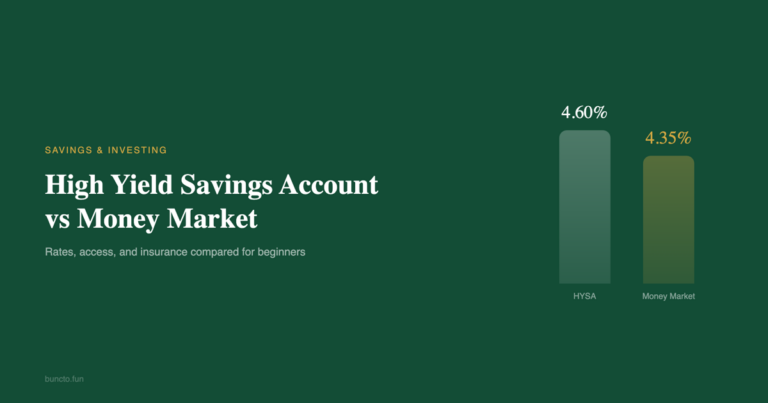
Money market accounts function like HYSAs but add check-writing and sometimes debit card access. Rates are comparable. The advantage is direct spending access; the disadvantage is that some money market accounts require higher minimum balances (,500-0,000).
For budgeting strategies that use multiple savings buckets, see our guide on budgeting apps for freelancers, which covers how to manage irregular income with HYSAs and sub-accounts.
How are HYSA earnings taxed?
Interest earned in an HYSA is taxed as ordinary income at your marginal tax rate. The bank sends a 1099-INT if you earn 0 or more in interest during the year. At 4.50% APY on 0,000, you earn about 50 — taxable at your regular income rate, not the lower capital gains rate.
For someone in the 22% federal tax bracket, 50 in HYSA interest means roughly 9 in additional federal tax. State income tax applies in most states as well. Some states, like New York, also tax savings interest. A few states, like Florida and Texas, have no state income tax.
This does not make HYSAs a bad deal. A 4.50% APY taxed at 22% still nets 3.51% after federal tax — far higher than the 0.46% average traditional savings rate. But it is worth knowing the actual net return, especially when comparing HYSAs to tax-advantaged alternatives like I-Bonds (interest is deferred and state-tax-exempt) or municipal money market funds.
Frequently Asked Questions
No, if the bank is FDIC-insured and your balance is under 50,000. The principal is guaranteed. You can lose purchasing power if the interest rate is lower than inflation, but you will not lose actual dollars. HYSAs are not investments — they are insured deposits.
Standard ACH transfers take 1-3 business days. Some banks, like Ally, offer same-day transfers for a fee. If your HYSA is at the same institution as your checking account (like SoFi), transfers can be instant. Wire transfers are typically same-day but may cost 0-0.
Most banks have no maximum deposit limit, but FDIC insurance only covers 50,000 per depositor per bank. You can deposit more, but the excess is uninsured. Wealthfront and some others offer extended coverage by distributing funds across multiple partner banks.
Yes, provided the bank is FDIC-insured. Online banks are regulated by the same federal agencies as traditional banks. They use the same encryption, fraud monitoring, and deposit insurance. The only difference is the absence of physical branches, which does not affect the safety of your deposits.
One or two is sufficient for most people. One for your emergency fund, and optionally a second for a specific savings goal. More accounts add complexity and multiple 1099-INT forms at tax time. The interest rate difference between the top five HYSAs is usually negligible.
Sources
- FDIC — National Rates and Rate Caps (accessed Aug 2026)
- FDIC — Understanding Deposit Insurance
- Federal Reserve — Open Market Operations
- Marcus by Goldman Sachs — HYSA Terms (accessed Aug 2026)
- Ally Bank — Online Savings Account (accessed Aug 2026)
- Wealthfront — Cash Account Details (accessed Aug 2026)
- IRS — Publication 550: Investment Income and Expenses