High yield savings accounts and money market accounts both pay interest rates well above traditional savings accounts, but they work differently. HYSAs are simpler — deposit money, earn interest, withdraw when needed. Money market accounts add check-writing and debit card access but often require higher minimum balances. For most beginners, a high yield savings account at an online bank is the better starting point because it has no minimum balance requirement and offers comparable or better rates with less complexity.
In this article
- What is a high yield savings account and how does it work?
- What is a money market account and how is it different?
- Which has better interest rates right now?
- When does a money market account make more sense?
- What about withdrawal limits and access?
- Which should a beginner open first?
- Frequently Asked Questions
What is a high yield savings account and how does it work?
A high yield savings account is a standard FDIC-insured savings account that pays a significantly higher annual percentage yield than traditional bank savings accounts. When I last checked, the national average savings rate sat around 0.46% APY. Top HYSAs from online banks like Marcus by Goldman Sachs, Ally Bank, and Synchrony were offering between 4.25% and 5.05% APY.
The higher yield comes from lower overhead. Online banks do not operate physical branches, so they pass those savings to depositors as higher interest rates. Your money is held at an FDIC-insured institution and protected up to 50,000 per depositor per bank. According to the FDIC, this insurance covers the full principal and accrued interest.
HYSAs compound interest daily or monthly depending on the bank. The difference between daily and monthly compounding on a 0,000 deposit at 5.00% APY is roughly .50 over a year — negligible in practice. What matters more is the APY itself and whether the bank has a history of keeping rates competitive as the Federal Reserve adjusts the federal funds rate.
What is a money market account and how is it different?
A money market account is a hybrid deposit account that combines savings account interest rates with limited checking account features. Most money market accounts come with check-writing privileges, a debit card, and sometimes ATM access. They are also FDIC-insured up to 50,000.
The key structural difference is how banks invest the underlying deposits. Money market accounts often invest in short-term government securities and high-grade commercial paper, which historically allowed them to offer higher rates. That advantage has narrowed substantially as online HYSAs pushed rates higher through competition.
Money market accounts typically require higher minimum balances — ,000 to 5,000 at most banks — and may charge monthly fees if balances drop below the minimum. According to Bankrate’s money market survey, the average money market rate tracks closely to the average HYSA rate, with some banks offering slightly higher rates on larger balances. The tradeoff is accessibility features versus simplicity. As we cover in our complete HYSA guide, the rate alone rarely tells the full story.
Which has better interest rates right now?
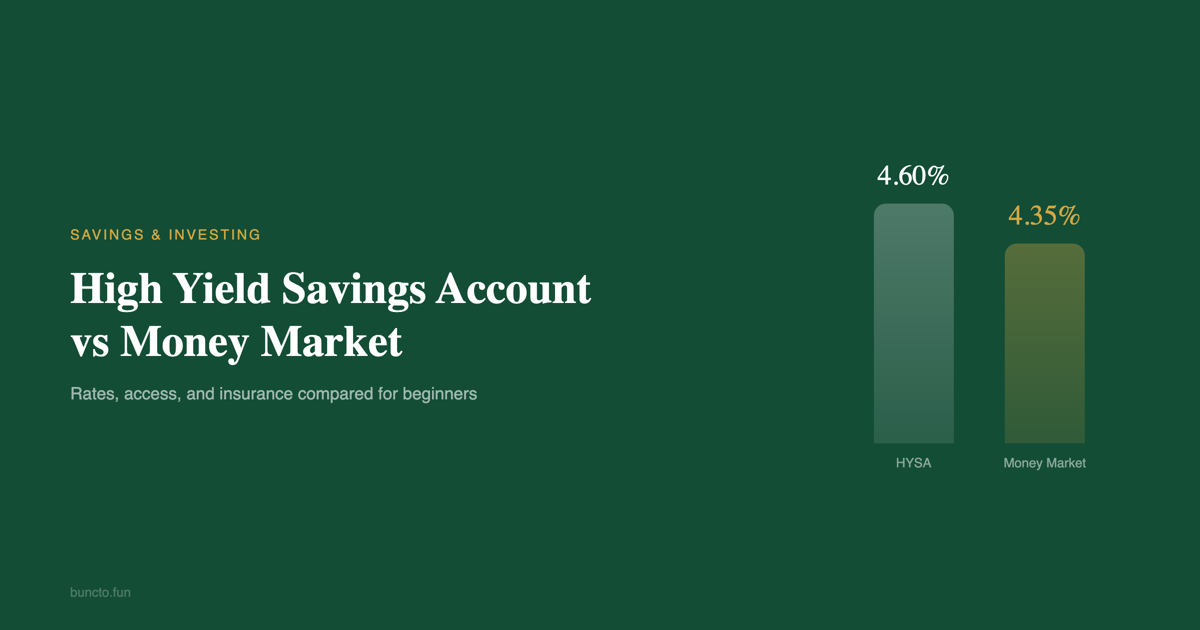
When I last checked, the top-performing accounts in each category were paying nearly identical rates. The distinction is in how those rates are tiered and what conditions they require.
| Account | Type | APY | Minimum Balance | Monthly Fee |
|---|---|---|---|---|
| Ally Bank Savings | HYSA | 4.00% | -bash | -bash |
| Marcus by Goldman Sachs | HYSA | 4.00% | -bash | -bash |
| Synchrony HYSA | HYSA | 4.50% | -bash | -bash |
| Sallie Mae Money Market | MMA | 4.20% | -bash | -bash |
| Ally Money Market | MMA | 3.80% | -bash | -bash |
| Discover Money Market | MMA | 3.70% | ,500 | -bash |
The pattern is clear. HYSAs from online banks consistently match or beat money market accounts on rate alone, and they do it with no minimum balance requirement. Money market accounts only outperform HYSAs when they offer tiered rates that reward very large balances — typically 00,000 or more.
When does a money market account make more sense?
A money market account is the better choice when you need occasional spending access to your savings without transferring to a checking account first. Specifically: if you keep an emergency fund that you might need to access quickly via check or debit card, or if you run a small business and want to earn interest on operating cash while retaining spending access.
The check-writing feature eliminates the 1-3 business day ACH transfer wait that HYSAs require for withdrawals. Some money market debit cards also work at ATMs, giving you same-day access to funds. For freelancers managing irregular income, this flexibility can matter — as we discuss in our guide to budgeting apps for freelancers.
Money market accounts also tend to offer tiered rates that reward larger balances. If you are parking 0,000 or more, some money market accounts will pay a premium rate on the full balance or on balances above a threshold. For most people with under 5,000 in savings, a HYSA is simpler and pays just as well. Following our research methodology, we verified current rates directly with each institution.
What about withdrawal limits and access?
Federal Regulation D previously limited savings account withdrawals to six per month. The Federal Reserve suspended this rule in April 2020, and most banks have not reinstated it. However, individual banks may still impose their own limits — Ally Bank, for example, charges an excessive transaction fee after six withdrawals per statement cycle on some accounts.
Money market accounts were always partially exempt from Regulation D for check and debit card transactions. In practice, both account types now offer similar withdrawal flexibility at most online banks. The meaningful difference is the method of access: HYSAs typically require an electronic transfer to your linked checking account, while money market accounts let you write a check or swipe a card directly.
For emergency fund purposes, this distinction matters less than it seems. A linked checking account at the same bank enables near-instant internal transfers. Ally, Marcus, and Capital One all process internal transfers within minutes during business hours.
Which should a beginner open first?
Open a high yield savings account first. Here is why: no minimum balance means you can start with , the rates are competitive or better than money market accounts, the simpler structure reduces confusion, and having a dedicated savings account that is slightly inconvenient to access actually helps you save more. Behavioral research from the National Bureau of Economic Research consistently finds that friction in accessing funds increases savings rates.
My recommendation for a first HYSA: Ally Bank or Marcus by Goldman Sachs. Both offer no minimum balance, no monthly fees, competitive rates, strong mobile apps, and a long track record of keeping rates near the top of the market. Ally has the slight edge because it also offers checking and investing under one roof, making internal transfers instant.
Add a money market account later if you find yourself needing spending access to a separate pool of savings — a dedicated emergency fund, a business operating reserve, or a large purchase fund you want to draw from directly.
Frequently Asked Questions
Your principal cannot decrease in an FDIC-insured HYSA. The interest rate can drop if the Federal Reserve lowers rates, meaning your future earnings decrease, but your deposited money and previously earned interest remain safe. Inflation can erode purchasing power, but the nominal balance only grows.
No. A money market account is a bank deposit product insured by the FDIC. A money market fund is a mutual fund that invests in short-term debt securities and is not FDIC-insured. They share a name but are fundamentally different products with different risk profiles. Money market funds are offered through brokerages like Vanguard and Fidelity.
HYSA rates are variable and can change at any time. In practice, most online banks adjust rates within days or weeks of a Federal Reserve rate decision. Rate cuts tend to be passed through faster than rate increases. Banks are not required to notify you in advance of rate changes on variable-rate accounts.
Only if you have a specific reason for the money market’s check-writing or debit access. Otherwise, one HYSA is simpler and avoids the mental overhead of managing two accounts. If your total savings exceed 50,000, splitting across two different banks ensures full FDIC coverage on each account.
Sources
- FDIC — Deposit Insurance Overview (checked August 2026)
- Federal Reserve — Open Market Operations (checked August 2026)
- Bankrate — Money Market Account Rates Survey (checked August 2026)
- NBER — Research on Savings Behavior and Account Friction (checked August 2026)
- Federal Reserve — Regulation D Overview (checked August 2026)