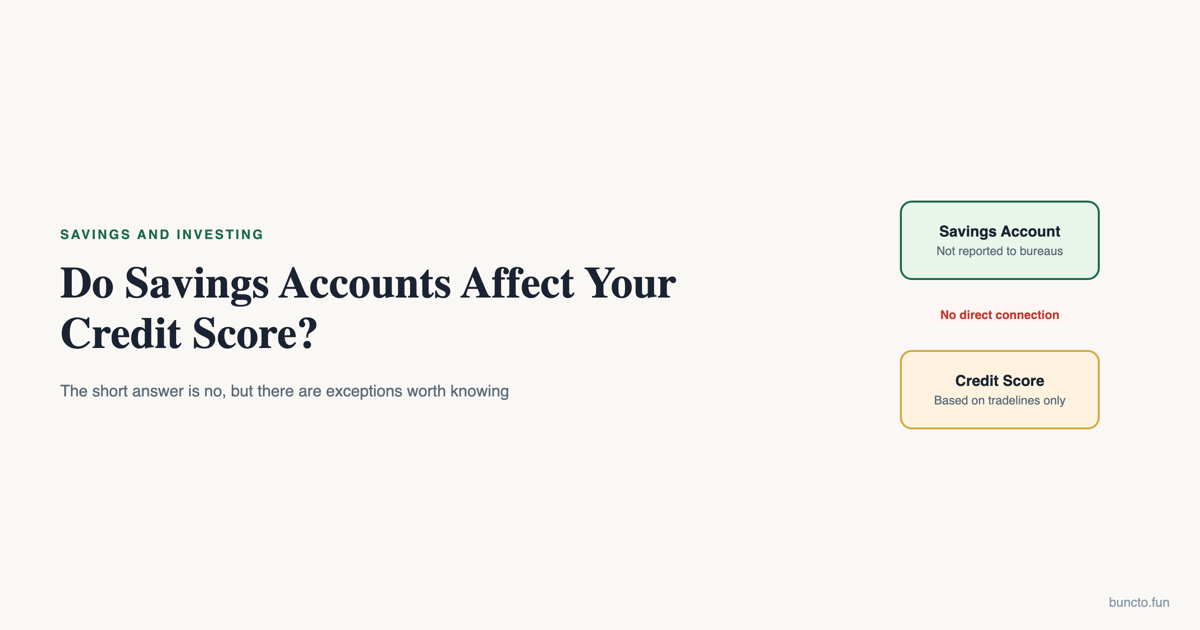
Quick answer: No, savings accounts do not affect your credit score. Banks do not report savings account activity to Equifax, Experian, or TransUnion. Opening, closing, or holding a savings account has zero direct impact on your FICO or VantageScore. However, your banking history is tracked separately by ChexSystems, and certain savings-adjacent products like overdraft lines of credit or CDs used as loan collateral can appear on your credit report.
In this article
Why Don’t Savings Accounts Show Up on Credit Reports?
Credit bureaus track credit activity — borrowing and repaying money. A savings account is a deposit product, not a credit product. You are lending money to the bank (your deposit), and the bank is paying you interest. There is no loan, no credit line, and no repayment schedule to report.
According to FICO, credit scores require at least one tradeline open for 6 months. A tradeline is a credit account: a credit card, loan, mortgage, or line of credit. Savings accounts, checking accounts, and money market accounts are not tradelines. They will never appear on your Equifax, Experian, or TransUnion credit report regardless of how much money you hold or how long the account has been open.
This is one of the most common misconceptions in personal finance. Having 0,000 in a high yield savings account does not improve your credit score by a single point. Having -bash in savings does not hurt it. Credit scoring models are completely blind to your deposit balances. For our approach to verifying facts like this, see our research methodology.
What Is ChexSystems and How Does It Affect Your Banking?
ChexSystems is a consumer reporting agency that tracks your banking history, not your credit history. When you apply for a new checking or savings account, most banks check your ChexSystems report instead of — or in addition to — your credit report. ChexSystems records negative banking events: bounced checks, unpaid overdrafts, accounts closed by the bank for misuse, and suspected fraud.
A negative ChexSystems record can prevent you from opening new bank accounts for up to 5 years. This is why people with ChexSystems flags often turn to neobanks, which typically do not use ChexSystems for account opening. Chime, Varo, and Current all skip the ChexSystems check.
ChexSystems is completely separate from credit bureaus. A ChexSystems flag will not lower your FICO score. A perfect FICO score will not override a ChexSystems flag. They are parallel systems that do not communicate with each other.
| Feature | Credit Report (Equifax, Experian, TransUnion) | ChexSystems Report |
|---|---|---|
| What it tracks | Credit accounts (loans, cards, mortgages) | Banking accounts (checking, savings) |
| Score type | FICO Score, VantageScore | ChexSystems Consumer Score (0-899) |
| Who checks it | Lenders, landlords, employers | Banks when you open an account |
| Negative record duration | 7-10 years | 5 years |
| Savings account reported | No | Only if closed for cause |
| Affects credit score | Yes | No |
Are There Any Exceptions Where Savings Can Affect Your Credit?
There are a few edge cases where savings-adjacent activity can touch your credit report. None of these involve a standard savings account.
Overdraft line of credit. Some banks attach a line of credit to your checking account as overdraft protection. This is a credit product, not a deposit feature. It appears on your credit report and affects your score like any other revolving credit line. If you opted into an overdraft line of credit and carry a balance, that shows up.
CD-secured loans. A certificate of deposit used as collateral for a personal loan creates a tradeline. The CD itself is not reported, but the loan backed by the CD is. This is actually a strategy some people use to build credit — similar to how secured credit cards and credit builder loans work.
Savings-backed credit builder products. Some fintech apps offer credit-building products funded by your savings. Self, MoneyLion, and similar services create a tradeline that reports to all three bureaus, according to their terms of service. These are credit products that use your savings as collateral — the savings account itself is not what gets reported.
Does Having More Savings Help You Get Approved for Loans?
Yes, but not through your credit score. When you apply for a mortgage, auto loan, or personal loan, lenders look at more than your FICO score. They review your full financial picture, including cash reserves — the amount of money you have in savings and investment accounts.
Mortgage lenders specifically want to see several months of reserves after the down payment and closing costs. The exact requirement varies: conventional loans typically require 2 to 6 months of reserves for investment properties, while primary residence purchases may require none. Having a healthy savings balance strengthens your overall application even though it never touches your credit score.
FDIC insurance covers up to 50,000 per depositor per insured bank, according to FDIC.gov. For large savings balances, verify your bank is FDIC-insured and understand the per-depositor limits before concentrating funds. Neobanks partner with FDIC-insured banks for pass-through insurance, which means your deposits at digital banks like Chime or SoFi are typically protected up to the same 50,000 limit.
What Actually Builds Your Credit Score if Savings Don’t?
Credit scores are built exclusively through credit activity. The five FICO score factors are payment history (35%), amounts owed (30%), length of credit history (15%), new credit (10%), and credit mix (10%). Every one of these requires an active tradeline.
The fastest ways to build credit from scratch using fintech tools: a secured credit card (reports to all three bureaus, requires a deposit), a credit builder loan from Self or MoneyLion (reports to all three bureaus, payments start as low as 5/month), or becoming an authorized user on someone else’s credit card. Credit scores require at least one tradeline open for 6 months, according to FICO.
My recommendation: build credit and savings simultaneously. Open a high yield savings account for your emergency fund while running a credit builder product on autopay. The savings account protects you financially while the credit product builds your score. They serve different purposes, and treating them as connected is the mistake that leads to the misconception this article addresses.
Sources
- FICO — credit score factors and tradeline requirements
- FDIC — deposit insurance coverage limits
- ChexSystems — consumer reporting for banking history
- Consumer Financial Protection Bureau — banking and credit consumer guides
- AnnualCreditReport.com — free credit report access