Quick answer: Missing a buy now pay later payment triggers late fees ranging from -bash to per missed installment, depending on the provider. Since 2025, missed BNPL payments are reported to credit bureaus, meaning a single late payment can now damage your credit score. Afterpay pauses your account immediately, Klarna charges fees after a grace period, and Affirm reports delinquency to credit bureaus on longer-term loans.
In this article
What Happens Immediately When You Miss a BNPL Payment?
The provider freezes your ability to make new purchases and begins a collection sequence that varies by company. Afterpay blocks your account after one missed payment and adds a late fee. Klarna sends reminders before charging penalties. Affirm does not charge late fees but reports the missed payment.
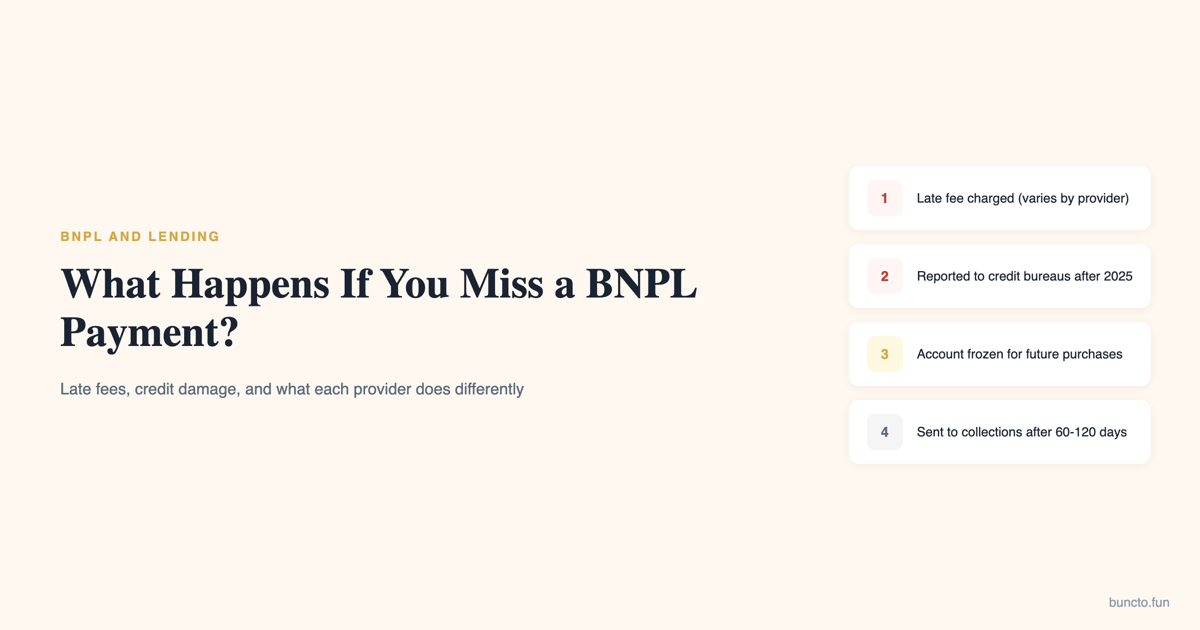
The first 24 to 48 hours are a grace window with most providers. Afterpay’s system is the most aggressive — it locks you out of new purchases immediately and charges up to per order in late fees (capped at 25% of the order total). Klarna sends email and app notifications before escalating. Affirm takes a softer approach with no late fees on any plan, but the missed payment still shows on your account history.
All three providers attempt automatic retry on your linked payment method. If the retry fails, the sequence moves to manual payment reminders, account restrictions, and eventually collections. The timeline from first missed payment to collections referral is typically 60 to 120 days. Read our complete BNPL guide for how these services work before you owe on one.
Does a Missed BNPL Payment Affect Your Credit Score?
Yes, it does now. Affirm, Klarna, and Afterpay all report to at least one credit bureau as of 2025, according to announcements from each provider. BNPL late payments began affecting credit reports more broadly in 2025, as confirmed by credit bureau announcements. This is a significant change from earlier years when most BNPL activity was invisible to credit scoring models.
The impact depends on the plan type. Short-term pay-in-four plans historically stayed off credit reports, but reporting policies have expanded. Longer installment loans through Affirm — the 3, 6, or 12-month plans — have reported to Experian and TransUnion for several years. Klarna now reports both on-time and late payments to TransUnion. Afterpay reports to Equifax.
A single 30-day-late BNPL payment can drop a credit score by 60 to 100 points, similar to a missed credit card payment. The damage is worse for people with thin credit files or scores above 750. The full breakdown of BNPL credit impact covers how to check whether your provider is reporting and what appears on your report.
How Much Are BNPL Late Fees by Provider?
Afterpay charges up to per late payment capped at 25% of the order. Klarna charges up to . Affirm charges zero late fees on all plans. The fee structures differ enough that the provider you chose matters more than the purchase amount.
| Provider | Late Fee | Fee Cap | Grace Period | Credit Reporting | Account Freeze |
|---|---|---|---|---|---|
| Afterpay | per missed payment | 25% of order total | None | Equifax | Immediate |
| Klarna | Up to | Varies by state | ~10 days | TransUnion | After grace period |
| Affirm | -bash | N/A | N/A | Experian, TransUnion | After 30+ days |
| Zip (formerly Quadpay) | – | Varies | ~7 days | Limited | After missed payment |
State regulations affect these fees. Some states cap or ban late fees on short-term installment plans entirely. Check your provider’s terms for your specific state. Affirm’s no-fee policy is the most consumer-friendly, but its credit reporting is also the most aggressive — you trade fee savings for credit risk.
Can a Missed BNPL Payment Go to Collections?
Yes. All major BNPL providers refer unpaid balances to third-party collection agencies after 60 to 120 days of non-payment. Once the debt reaches collections, it appears as a separate negative item on your credit report, compounding the damage from the original missed payment.
The collections timeline works like this. After the initial missed payment and automatic retries fail, the provider sends escalating reminders over 30 to 60 days. If you do not pay or arrange a payment plan, the account moves to an internal recovery team. After another 30 to 60 days of failed recovery, the provider sells or assigns the debt to an external collection agency.
A collections account stays on your credit report for seven years from the date of the original delinquency. Even paying the collections balance does not remove it — it changes the status to “paid collection” but remains visible to lenders. For a 0 or 00 BNPL purchase, the long-term credit damage far exceeds the original amount. Contact the provider directly before it reaches this stage. Most offer hardship payment plans if you reach out within the first 30 days.
How Do You Fix a Missed BNPL Payment?
Pay the overdue amount immediately through the app, contact the provider to request a payment plan, and check your credit report 30 days later to verify the status. Acting within the first few days limits the damage. Waiting past 30 days is when credit reporting kicks in for most providers.
Step one: open the app and pay the overdue installment. Afterpay and Klarna accept immediate payment through their apps. Affirm processes payments through the original payment method or allows manual bank transfer. If you cannot pay the full amount, contact customer support directly — all three providers have hardship programs that can pause payments or extend deadlines.
Step two: check whether the late payment was reported. Pull your free credit reports from annualcreditreport.com. If the late payment appears and you paid within 30 days, dispute it with the bureau — some providers only report payments that are 30+ days late. Step three: set up autopay to prevent future missed payments. Every BNPL provider offers automatic payment from a linked bank account or debit card. This is the single most effective prevention. Our research methodology page explains how we verify these provider policies.
Should You Avoid BNPL Entirely Because of the Risks?
No, but you should only use BNPL for planned purchases you can afford to pay for outright. The risk is not in the product — it is in using BNPL to buy things you cannot afford and then missing payments that now hit your credit score.
BNPL works well in specific scenarios: splitting a larger purchase into four interest-free payments when you have the cash but prefer to keep it liquid, or using a 0% APR Affirm plan for a necessary appliance. It breaks down when used repeatedly for small impulse purchases, creating a stack of overlapping payment obligations that become difficult to track.
My judgement: the 2025 credit reporting changes made BNPL a real credit tool, not a consequence-free payment method. Treat it like a credit card payment. If you would not put it on a credit card, do not BNPL it. And always enable autopay the moment you create a new BNPL plan. The convenience is genuine — the risk is manageable if you treat each installment as a fixed obligation, not an optional payment.
Sources
- Afterpay — late fee policy and account terms (afterpay.com)
- Klarna — payment terms and late fee schedule (klarna.com)
- Affirm — no late fee policy and credit reporting disclosure (affirm.com)
- Experian — BNPL credit reporting changes (experian.com)
- TransUnion — BNPL data integration announcement
- Consumer Financial Protection Bureau — BNPL market report (consumerfinance.gov)
- Annual Credit Report — free credit report access (annualcreditreport.com)