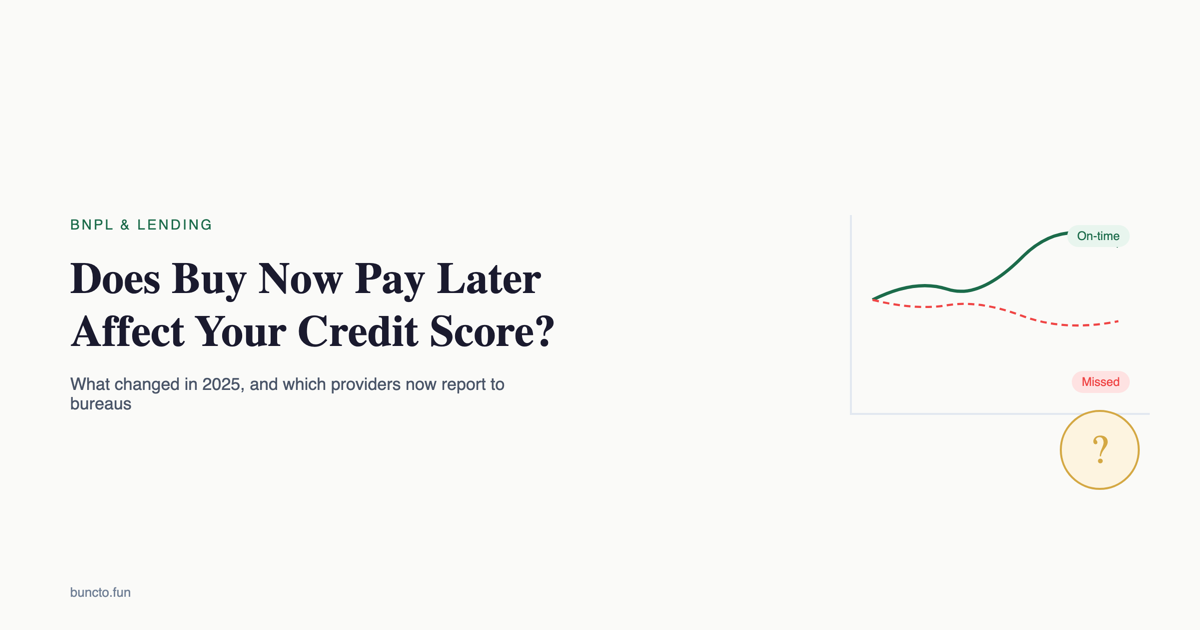
Yes, buy now pay later can affect your credit score — but the impact depends entirely on which provider you use, which payment plan you choose, and whether you pay on time. Affirm reports all installment loans to Experian. Klarna reports missed payments to all three bureaus. Afterpay began reporting to TransUnion and Equifax in 2025. Short-term pay-in-four plans have minimal impact when paid on time; longer installment loans create tradelines that can help or hurt your score just like any other loan.
In this article
Which BNPL providers report to credit bureaus?
The reporting landscape changed significantly in 2025 when all three major bureaus — Experian, Equifax, and TransUnion — finalized frameworks for incorporating BNPL data. Before that, most providers only reported missed payments. Now, several major BNPL companies report both positive and negative payment history.
According to Experian’s BNPL reporting guide, the bureau now accepts BNPL tradeline data under a specialized format that distinguishes installment plans from revolving credit. This matters because BNPL accounts are scored differently than credit cards in newer FICO and VantageScore models.
| Provider | Reports On-Time Payments | Reports Late Payments | Bureaus | Hard Pull at Checkout |
|---|---|---|---|---|
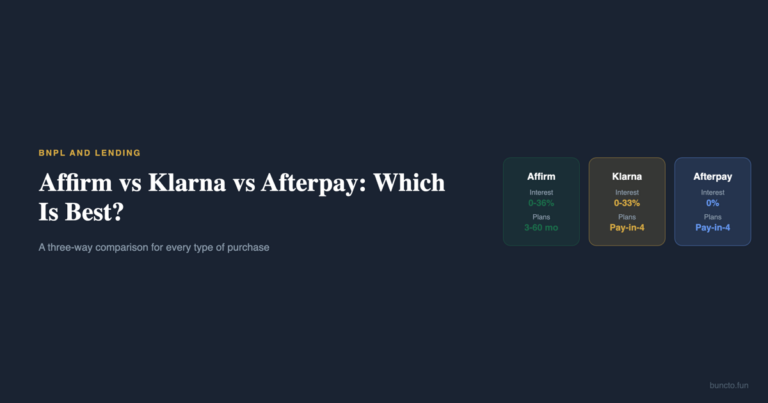
| Affirm | Yes (loans over 9) | Yes | Experian | Sometimes (longer terms) |
| Klarna | Yes (financing plans) | Yes | TransUnion, Equifax | No (soft pull) |
| Afterpay | Yes (began 2025) | Yes | TransUnion, Equifax | No |
| PayPal Pay Later | Yes (Pay Monthly) | Yes | Equifax | Yes (Pay Monthly) |
| Zip (formerly Sezzle) | Limited | Yes | Varies | Sometimes |
The key detail: short-term pay-in-four plans (Afterpay’s standard product, Klarna’s Pay in 4) are treated differently from longer installment loans (Affirm’s 3-36 month financing, Klarna’s financing). Longer-term plans are more likely to appear as full tradelines on your report and more likely to require a hard credit pull at checkout.
How can BNPL actually help your credit score?
BNPL accounts that report on-time payments create positive tradelines on your credit report. For people with thin credit files — few existing accounts — this additional payment history can improve scores by diversifying the types of credit and adding on-time payment data. The Consumer Financial Protection Bureau reports that BNPL users are more likely to have subprime scores, making the positive reporting particularly impactful for credit building.
Affirm’s installment loans are the clearest example. A 00 purchase financed over 12 months at 0% APR creates a tradeline that reports monthly payment activity to Experian. Twelve consecutive on-time payments contribute to your payment history, which makes up 35% of your FICO score. For someone building credit alongside tools like secured cards or credit builder loans, this adds another reporting account without requiring a hard inquiry in many cases.
VantageScore 4.0 explicitly incorporates BNPL data into scoring, and FICO has signaled that future score versions will do the same. As BNPL reporting becomes standard, consistent on-time payments across providers will contribute to creditworthiness the same way traditional installment loans do.
How can BNPL hurt your credit score?
Late or missed BNPL payments damage your score through the same mechanisms as any late payment. A payment reported 30+ days late to a credit bureau can drop your score by 50-100 points depending on your starting score and existing payment history. The FICO scoring model weights payment history most heavily.
Multiple BNPL accounts opened in a short period can also trigger concerns. Each account that requires a hard inquiry reduces your score slightly. Even soft-pull accounts create new tradelines that lower your average account age — a factor in 15% of your FICO score. Opening five BNPL plans in a month for separate purchases creates five new accounts, even if none required a hard pull.
The less obvious risk is utilization-adjacent. While BNPL accounts are not revolving credit and technically have no utilization ratio, scoring models are still evolving to assess how multiple outstanding BNPL obligations affect overall debt burden. Having ,000 in active BNPL obligations alongside credit card balances signals higher total indebtedness to lenders reviewing your full credit report, even if the score itself does not penalize it yet.
Do BNPL hard inquiries matter?
Hard credit pulls reduce your score by approximately 5-10 points and remain on your report for two years. Most short-term pay-in-four plans use soft pulls that do not affect your score. Longer-term financing options are more likely to require a hard inquiry.
Affirm performs soft pulls for pre-qualification and may perform a hard pull when you finalize a longer-term loan. PayPal’s Pay Monthly option consistently requires a hard pull. Klarna’s financing plans may require a hard inquiry depending on the amount and your credit profile. The provider’s checkout page should disclose whether a hard or soft pull will occur — look for this before confirming.
For comparison, as we explain in our complete BNPL guide, applying for a traditional credit card always requires a hard pull. The relative advantage of BNPL is that many options avoid hard inquiries entirely, though this advantage diminishes for larger or longer-term financing. If you are concerned about protecting your score while making payments, our analysis of Venmo for large payments covers alternative approaches.
What actually happens if you miss a BNPL payment?
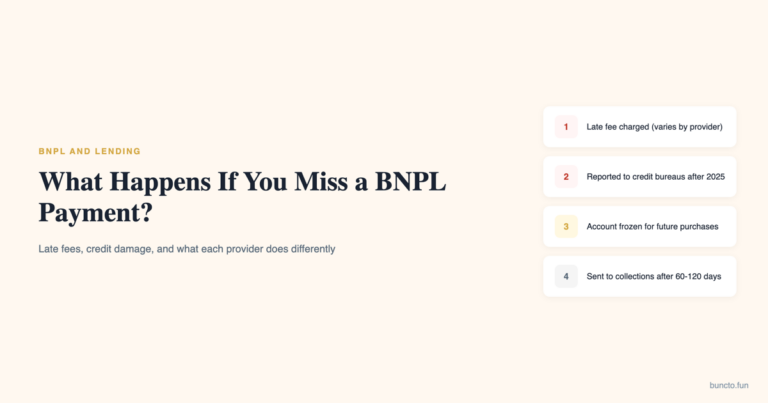
The consequences follow a predictable escalation: late fee, account freeze, bureau reporting, then collections. Each provider handles the timeline differently.
Afterpay pauses your account after one missed payment and does not charge late fees in most states. Klarna charges late fees after a grace period and reports to bureaus after sustained non-payment. Affirm does not charge late fees on most plans but reports missed payments to Experian, which directly impacts your credit score. According to Afterpay’s terms of service, accounts with unpaid balances exceeding 120 days may be referred to collections agencies.
Collections is the nuclear outcome. A BNPL account sent to collections creates a separate derogatory mark on your credit report that persists for seven years. A 0 Afterpay purchase that spirals into collections causes the same credit damage as a ,000 medical bill in collections. Following our research methodology, we verified late payment policies directly with each provider’s current terms.
| Provider | Late Fees | Grace Period | Bureau Reporting Starts | Sent to Collections |
|---|---|---|---|---|
| Afterpay | None (most states) | Immediate pause | After sustained default | ~120 days |
| Klarna | Up to /installment | 10 days | After 60+ days | ~90 days |
| Affirm | None | Varies by plan | 30 days late | ~120 days |
| PayPal Pay Later | Up to 0 | 10 days | 30 days late | ~90 days |
Should you use BNPL to build credit on purpose?
Using BNPL solely to build credit is a weaker strategy than alternatives designed specifically for credit building. A secured credit card or credit builder loan offers more predictable reporting, builds a longer tradeline, and contributes to credit mix diversification in a way that BNPL accounts do not yet replicate in all scoring models.
That said, if you are already using BNPL for purchases you would make anyway, choosing providers that report positive payment history is a net benefit. Affirm’s 0% APR installment plans are the best candidate — they report reliably, charge no late fees, and create genuine installment tradelines. Using BNPL responsibly as a supplement to secured cards and credit builder loans adds reporting diversity without additional cost.
My honest assessment: BNPL is a spending tool that can incidentally help credit. It is not a credit-building tool that incidentally enables spending. If building credit is your primary goal, start with purpose-built products. Use BNPL when it genuinely saves you money through 0% financing on purchases you planned to make regardless.
Frequently Asked Questions
As of 2025, Afterpay reports payment data to TransUnion and Equifax. Both on-time and missed payments can appear. Earlier Afterpay activity before the reporting change does not appear retroactively. Your Afterpay payment history only shows on reports from these two bureaus, not Experian.
Yes. Active BNPL installment plans appear as outstanding debts. Mortgage underwriters review your full credit report, and multiple active BNPL accounts can increase your debt-to-income ratio. Some lenders specifically ask about BNPL obligations. Pay off BNPL balances before applying for a mortgage if possible.
Yes. Klarna’s Pay in 4 (short-term, four payments over six weeks) uses a soft pull and has minimal credit impact when paid on time. Klarna’s longer financing plans (6-36 months) may require a hard pull, create a full tradeline, and have more significant scoring impact similar to a traditional installment loan.
Late payments reported to credit bureaus remain on your report for seven years from the date of the delinquency. This applies whether the late payment is from a BNPL provider, credit card, or any other creditor. Collections accounts also remain for seven years from the original delinquency date.
Sources
- Experian — Will BNPL Affect Your Credit Score (checked August 2026)
- CFPB — Report on BNPL Lending (checked August 2026)
- myFICO — How Debt Amounts Affect Your Score (checked August 2026)
- Afterpay — Terms of Service (checked August 2026)
- TransUnion — BNPL and Your Credit Report (checked August 2026)