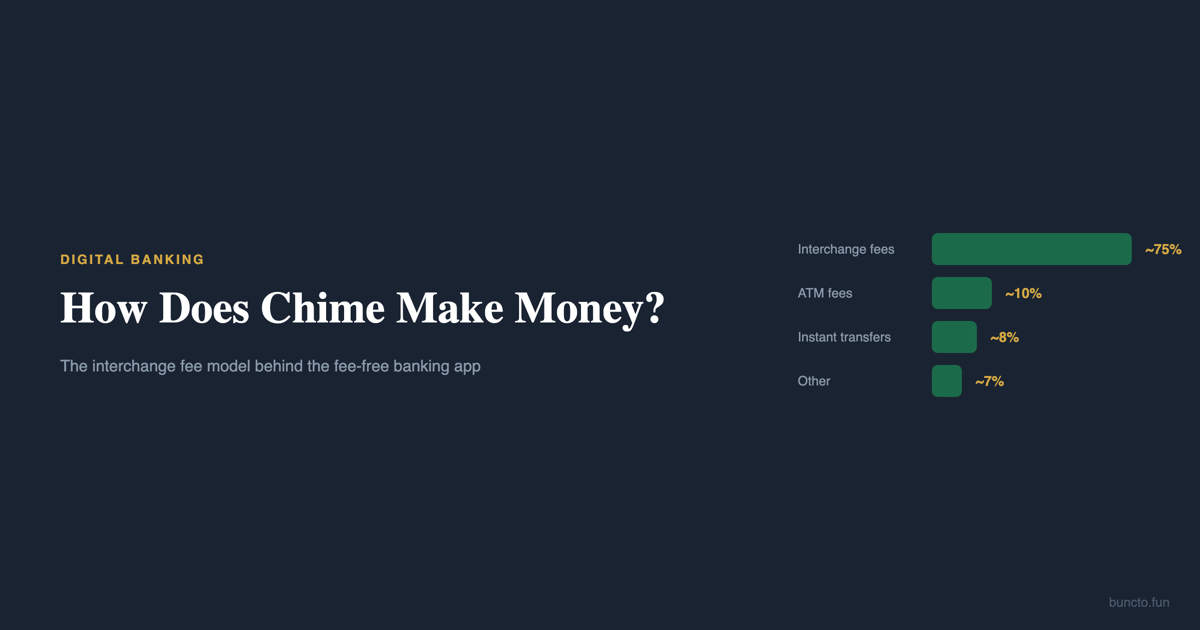
Quick answer: Chime makes money primarily through interchange fees — the small percentage merchants pay every time you swipe your Chime debit card. With over 7 million active users making daily purchases, these fractions of a cent add up to hundreds of millions in annual revenue. Chime does not charge monthly fees, overdraft fees, or minimum balance penalties.
What Are Interchange Fees and Why Do They Matter?
Interchange fees are the transaction fees merchants pay to card networks every time a customer uses a debit or credit card. For debit transactions, the fee is typically 0.5% to 1% of the purchase amount. Visa and Mastercard set these rates, and the issuing bank collects most of the fee.
Chime is not a bank. It partners with Bancorp Bank and Stride Bank, both FDIC-insured institutions that hold customer deposits. According to FDIC.gov, deposits are insured up to 50,000 per depositor per insured bank. When you swipe your Chime Visa debit card, the interchange fee flows through Visa to Bancorp or Stride, and Chime takes a share under its partnership agreement.
This is the core of the business. Chime needs you to use your debit card for everything — groceries, gas, subscriptions, coffee. Every swipe generates revenue. This is why Chime offers features like SpotMe and early direct deposit: they keep you spending through the Chime card instead of a competitor’s. For context on how neobanks operate, see our neobanks guide.
How Much Does Chime Earn Per Transaction?
Chime earns roughly -bash.15 to -bash.50 per debit card transaction, depending on the purchase amount and interchange rate tier. On a 0 grocery purchase, Chime’s share might be -bash.25 to -bash.35 after Visa and the partner bank take their cuts.
This sounds small. It is not. A user who spipes their Chime card 30 times per month generates roughly to 2 in interchange revenue. Multiply that across millions of users, and the math works. Reports indicate Chime’s annual revenue exceeds billion, with interchange fees accounting for the majority.
The model has a clear dependency: Chime needs high transaction volume. If users stop using the debit card — switching to credit cards for rewards, or moving their direct deposit elsewhere — Chime’s revenue drops. This is the structural risk in the business, and it explains every product decision Chime makes.
Does Chime Charge Any Fees at All?
Chime charges no monthly fees, no overdraft fees, and no minimum balance fees. It does charge for out-of-network ATM withdrawals and cash deposits through retail partners.
| Fee Type | Chime | Typical Traditional Bank |
|---|---|---|
| Monthly maintenance | -bash | -5 |
| Overdraft | -bash (SpotMe) | 5 per transaction |
| Minimum balance | -bash | -bash-5/month if under threshold |
| Out-of-network ATM | .50 | .50-.50 |
| Cash deposit (retail) | Up to .95 | -bash (in-branch) |
| Foreign transaction | Varies by partner bank | 1%-3% |
| Card replacement | -bash standard, 5 expedited | -5 |
Out-of-network ATM fees and cash deposit fees do generate some revenue, but these are minor compared to interchange. Chime provides over 60,000 fee-free ATMs through AllPoint and MoneyPass networks specifically to keep users from needing out-of-network machines.
Why Does Chime Offer Early Direct Deposit for Free?
Early direct deposit makes Chime your primary bank account, which maximizes the number of transactions flowing through its debit card. When your paycheck arrives two days early, you spend from Chime first. That is the entire strategy.
Most employers send payroll files to banks one to two business days before pay day. Traditional banks hold the funds until the official date. Chime releases them as soon as the file arrives. The feature costs Chime almost nothing to provide — it is a timing change, not a loan — but it creates strong retention.
Once a user sets up direct deposit with Chime, switching to another bank requires updating payroll with their employer. That friction keeps users in the Chime ecosystem. According to retention data from fintech analysts, direct deposit users churn at roughly one-third the rate of non-direct-deposit users. You can learn how to manage this process in our guide on switching banks without losing direct deposit.
Is Chime Actually Profitable?
Chime has reported profitability on a net-income basis, according to statements from its leadership ahead of its planned IPO. The company reached this milestone by keeping costs lower than traditional banks — no branches, no teller salaries, no physical infrastructure.
Chime’s cost structure is primarily customer acquisition (marketing), technology, and its revenue share with partner banks. Without branches, its cost-to-serve per customer is a fraction of what Chase or Bank of America spends. The interchange revenue model works at scale because marginal costs per new user are low.
The planned IPO filing will reveal exact financials. Until then, the profitability claim is based on company statements, not audited public filings. I think the model is sound — interchange revenue at scale with minimal physical overhead is proven — but investors should wait for the S-1 filing before drawing conclusions.
What Are the Risks in Chime’s Business Model?
Chime’s biggest risk is interchange rate compression from regulation or network changes. The Durbin Amendment already caps debit interchange for large banks. If similar regulation extends to fintech-partner arrangements, Chime’s revenue per swipe drops.
Competition is the second risk. Every neobank — Varo, Current, Dave, MoneyLion — competes for the same direct-deposit users. Traditional banks now offer fee-free checking and early direct deposit features of their own. When I last checked, Chase, Wells Fargo, and Bank of America all had early paycheck access on their mobile apps.
For an independent look at how different digital banks compare, see our neobank vs traditional bank breakdown. We explain our evaluation criteria on the methodology page.
Sources
- FDIC — Deposit Insurance Coverage
- Chime — Product Terms
- Visa Interchange Rate Schedule
- Durbin Amendment provisions — Federal Reserve
- Neobank market analysis — public filings and company statements