Quick answer: You can generate a FICO credit score in six months by opening one tradeline — a secured credit card or credit builder loan — and making every payment on time. Reaching a 670+ score typically takes 12 to 18 months with consistent on-time payments and low credit utilization. The exact timeline depends on which tools you use and how many tradelines you build simultaneously.
In this article
- How Long Until You Get a Credit Score?
- What Score Can You Expect at Each Milestone?
- Which Fintech Tools Build Credit the Fastest?
- What Mistakes Slow Down the Credit Building Timeline?
- Can You Build Credit Without a Social Security Number?
- What Does a Realistic First-Year Credit Building Plan Look Like?
- Sources
How Long Until You Get a Credit Score?
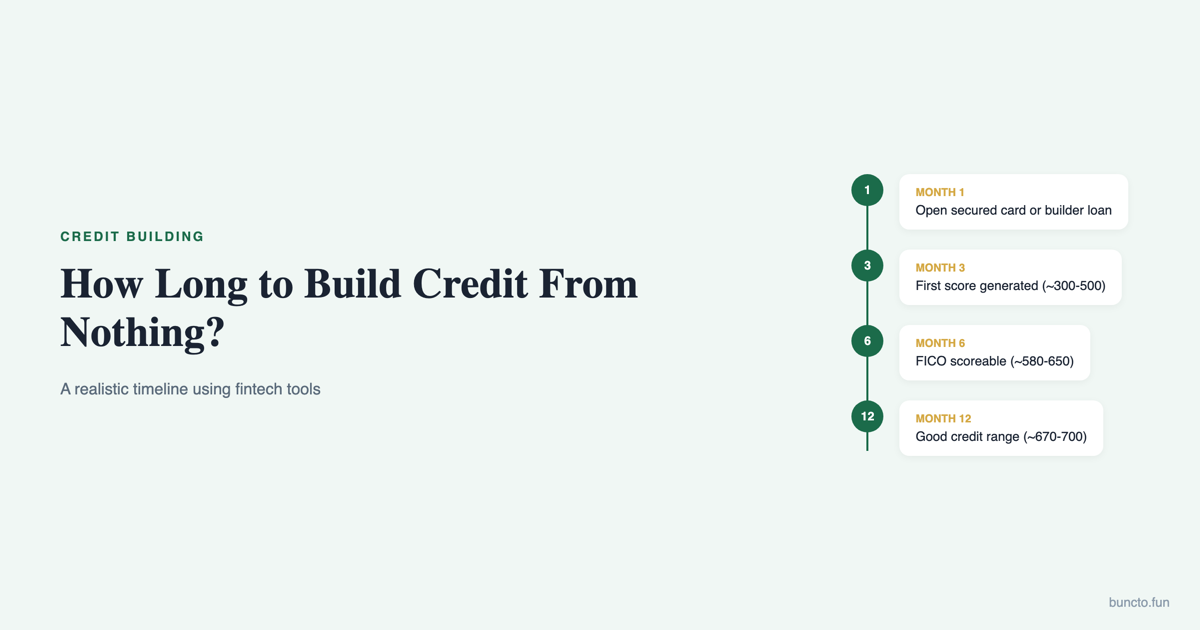
Six months is the minimum. According to FICO.com, you need at least one tradeline that has been open for six months and reported to a credit bureau within the last six months. Until that threshold is met, you have no FICO score — not a zero, but literally no score at all.
VantageScore generates a score faster. VantageScore 3.0 and 4.0 can produce a score with as little as one month of credit activity. However, FICO is used by 90% of top lenders for lending decisions. Building toward a FICO score is the practical target.
The six-month clock starts when the tradeline first reports to a bureau, not when you open the account. Most credit builder loans report within 30 to 45 days of your first payment. Secured credit cards typically report your first statement balance 30 days after the statement closes. For the full strategy, see our guide on building credit from scratch.
What Score Can You Expect at Each Milestone?
After six months of on-time payments on a single tradeline, most people with no prior credit history see an initial score between 580 and 650. The exact number depends on utilization, the type of tradeline, and whether any negative marks exist elsewhere.
| Timeline | Typical Score Range | What Becomes Available |
|---|---|---|
| 0-5 months | No FICO score | Credit builder loans, secured cards |
| 6 months | 580-650 | Some unsecured cards, rental approvals |
| 12 months | 640-700 | Most unsecured cards, auto loans |
| 18 months | 670-730 | Rewards credit cards, better auto rates |
| 24 months | 700-750+ | Competitive mortgage rates, premium cards |
These ranges assume perfect on-time payments and credit utilization below 30%. A single missed payment at the six-month mark can drop the score by 50 to 100 points and push every milestone back by months. The timeline is realistic for people who treat every payment as non-negotiable.
Which Fintech Tools Build Credit the Fastest?
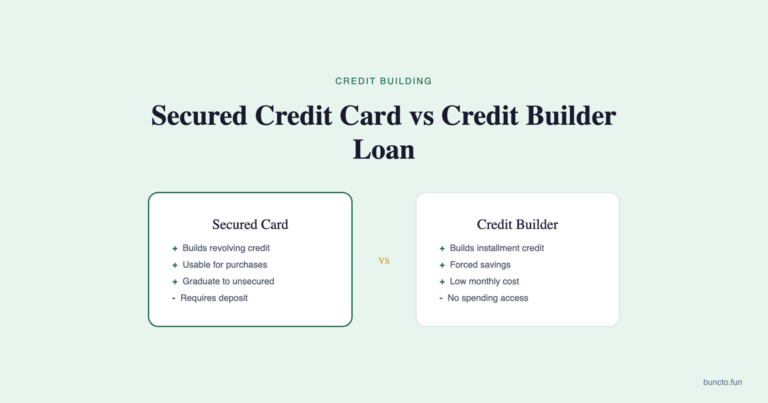
A secured credit card plus a credit builder loan running simultaneously creates both a revolving and an installment tradeline, which builds credit faster than either alone. FICO scores reward tradeline diversity — having more than one type of account in good standing strengthens your credit mix, which accounts for roughly 10% of your score.
Credit builder loans from Self and MoneyLion report to all three bureaus, according to their product terms. A secured credit card from Discover, Capital One, or Chime also reports to all three. Running both means three bureaus receive two positive tradelines every month.
Rent reporting services like Experian Boost and Rental Kharma add utility and rent payments to your report. These do not create tradelines in the traditional sense, but they add positive payment data that some scoring models incorporate. The effect is smaller than a credit card or loan, but every positive signal helps during the first year.
What Mistakes Slow Down the Credit Building Timeline?
High utilization, missed payments, and applying for too many accounts at once are the three most common mistakes that delay credit building by months.
Utilization is the most misunderstood factor. If your secured card has a 00 limit and you carry a 50 balance, your utilization is 75%. That tanks your score even if you pay on time. Keep utilization below 30% — ideally below 10%. On a 00 limit, that means never carrying more than 0 to 0 at statement time.
Each credit application generates a hard inquiry, which costs 3 to 5 points and stays on your report for two years. Three applications in a month can drop a thin file by 15 points. Apply only for products you are confident you will be approved for — one secured card and one credit builder loan in the first month, then nothing for at least six months.
A single missed payment during the first year of credit building is devastating. On a thin file, it can drop your score by 80 to 110 points. Set up autopay on every account before you receive the first bill. The cost of a 5 autopay you forgot to budget for is far less than the cost of a missed payment on your credit report.
Can You Build Credit Without a Social Security Number?
Yes. You can build credit using an Individual Taxpayer Identification Number (ITIN) at some banks and fintech providers. According to CFPB.gov, an ITIN can be used to apply for credit at some banks. The credit bureaus create files based on ITIN reporting the same way they do for SSN reporting.
Self and some credit unions accept ITIN applications for credit builder loans. Secured credit cards from select community banks also accept ITIN. The tradeline reports to the credit bureaus under your ITIN, building a credit history that is accessible once you obtain an SSN — the files merge. Our full guide on building credit as an immigrant without an SSN covers the process step by step.
What Does a Realistic First-Year Credit Building Plan Look Like?
Month one: open a secured credit card and a credit builder loan. Months two through twelve: autopay everything, keep utilization under 10%, and do not apply for anything else. That is the entire plan. Simplicity and consistency beat complexity.
The secured card handles daily spending. Use it for one or two small recurring charges — a streaming subscription, a phone bill — and set autopay to pay the full balance. The credit builder loan runs in the background with automatic monthly payments. Together they create two tradelines reporting to all three bureaus every month.
At month six, check your FICO score through your card issuer’s free score tool or through AnnualCreditReport.com for your full report. At month twelve, you should qualify for an unsecured credit card. Do not close the secured card — account age matters. I think the most common error is impatience. People apply for new credit too early, stack hard inquiries, and push their timeline back. Patience and autopay are the strategy. Everything else is noise. See our research methodology for how we evaluate credit-building tools.