Quick answer: Klarna is better for everyday shopping flexibility with its browser extension and pay-in-four option at virtually any store. Affirm is better for large planned purchases where you need fixed monthly payments over 3 to 60 months. Both report to credit bureaus, but Affirm reports more aggressively to Experian and TransUnion. Klarna charges late fees up to $7; Affirm charges none. Choose based on what you buy and how long you need to pay.
What Is the Core Difference Between Klarna and Affirm?
Klarna is a flexible shopping tool. Affirm is a financing tool. Klarna’s strength is its pay-in-four option and browser extension that works at almost any online retailer. Affirm’s strength is structured installment loans with fixed APRs for larger purchases at partner merchants like Amazon, Walmart, and Peloton.
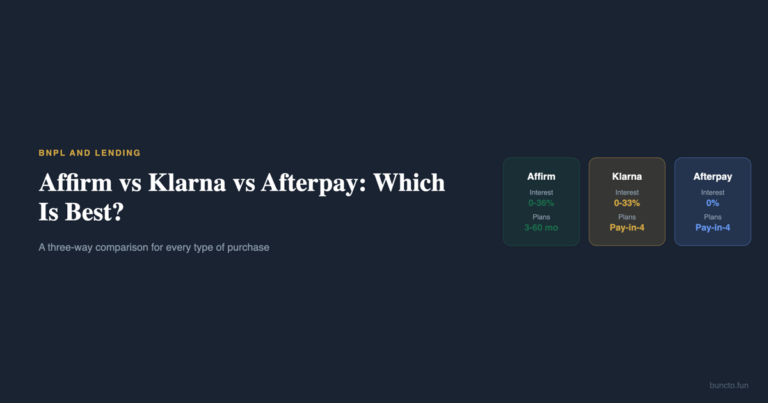
Klarna lets you split any purchase into four interest-free payments over six weeks, or choose monthly financing at 0% to 29.99% APR for longer terms. Its browser extension creates a one-time virtual card at checkout, which means you are not limited to Klarna’s merchant network. Affirm offers pay-in-four at select merchants, but its primary product is installment loans from 3 to 60 months at 0% to 36% APR.
The practical result: Klarna suits frequent online shoppers who want a single tool across many stores. Affirm suits people financing a specific large purchase with predictable monthly payments. For a broader three-way comparison including Afterpay, see our full BNPL comparison. Our research methodology explains how we evaluate these products.
Which Charges Less in Fees and Interest?
Affirm charges zero late fees on all plans. Klarna charges up to $7 per missed payment. On interest, both can be free or expensive depending on the plan. The fee and interest structure is the biggest practical difference between the two providers.
| Feature | Klarna | Affirm |
|---|---|---|
| Pay-in-4 interest | 0% always | 0% at select merchants |
| Monthly financing APR | 0%-29.99% | 0%-36% |
| Late fees | Up to $7 | $0 |
| Late fee grace period | ~10 days | N/A (no fees) |
| Minimum purchase | No minimum for pay-in-4 | Varies by merchant |
| Maximum loan amount | Varies by approval | Up to $17,500 |
| Early payoff penalty | None | None |
For short-term purchases paid in four installments, both are free. The difference emerges when something goes wrong. Miss a Klarna payment and you pay up to $7 per installment plus a frozen account. Miss an Affirm payment and you pay nothing in fees, but the delinquency hits your credit report. Affirm’s approach is arguably more consequential despite costing less upfront — credit damage outlasts a $7 fee. For more on what happens when payments slip, read our guide on missed BNPL payments.
How Does Credit Reporting Differ Between Klarna and Affirm?
Affirm reports to both Experian and TransUnion. Klarna reports to TransUnion only. Affirm, Klarna, and Afterpay all report to at least one credit bureau as of 2025, according to provider announcements. BNPL late payments began affecting credit reports more broadly that year, changing the calculus for every user.
Affirm’s dual-bureau reporting means both on-time and late payments appear on two of your three credit files. Longer-term Affirm loans of 6 to 60 months function as installment tradelines, adding payment history depth similar to an auto loan or personal loan. This helps people with thin credit files build history but also means delinquency appears in two places.
Klarna’s single-bureau reporting to TransUnion means the impact is narrower. A missed Klarna payment affects your TransUnion file but not Experian or Equifax. On-time Klarna payments similarly only build history at TransUnion. If you are actively building credit, Affirm’s broader reporting is more valuable. If you want minimal credit footprint, Klarna’s narrower scope is less risky.
Which Works at More Stores?
Klarna works at virtually any online store through its browser extension and one-time virtual card. Affirm is limited to its merchant partner network unless you use its virtual card feature. This is Klarna’s strongest competitive advantage.
Klarna’s browser extension detects online checkouts and offers to create a one-time Visa card number funded by your Klarna plan. The merchant never knows you used Klarna — they see a normal card payment. This works at any store that accepts Visa online, regardless of whether the store has a Klarna partnership.
Affirm integrates directly at checkout with hundreds of major retailers: Amazon, Walmart, Target, Peloton, Expedia, and others. The Affirm app also offers a virtual card for use at non-partner merchants, but availability and terms vary by user. The experience is smoother at partner merchants where Affirm is built into the checkout flow with transparent APR disclosure.
My view: if you shop across many different stores, Klarna’s universal coverage makes it the more practical daily tool. If you primarily shop at major retailers that already offer Affirm at checkout, the integrated experience is cleaner. Read our complete BNPL guide for more on how merchant integration works.
Which Is Better for Large Purchases Over $500?
Affirm is the clear winner for large purchases because it offers structured installment loans up to $17,500 with fixed monthly payments over 3 to 60 months. Klarna’s monthly financing exists but caps out earlier and has less transparent pre-approval.
Affirm shows your exact APR, monthly payment, and total cost before you commit. A $1,000 purchase at 0% APR over 12 months costs exactly $83.33 per month with no surprises. At 15% APR over 12 months, the total cost is roughly $1,083. The terms are fixed at checkout and do not change.
Klarna’s monthly financing works similarly in theory but is less widely available for larger amounts. Klarna’s pay-in-four option splits any purchase into four payments over six weeks — fine for a $200 jacket, but paying $250 every two weeks on a $1,000 purchase strains most budgets. For purchases that need months to pay off, Affirm’s longer terms and fixed-rate structure are better designed.
Which Should You Actually Choose?
Choose Klarna if you want one BNPL tool that works everywhere for everyday purchases. Choose Affirm if you are financing a specific large purchase and want fixed monthly payments with no late fees. Most people benefit from picking one and sticking with it rather than juggling both.
Klarna fits the casual shopper who splits $50 to $300 purchases across many different stores. Its browser extension removes the merchant limitation. Its pay-in-four is simple and interest-free. The downside is late fees and single-bureau reporting.
Affirm fits the planned buyer who is financing furniture, electronics, travel, or fitness equipment at a specific retailer. Its longer terms, no late fees, and dual-bureau reporting treat BNPL more like a real financial product. The downside is limited merchant coverage without the virtual card and potentially higher APRs on longer loans.
I think Affirm is the better product overall because its no-fee policy and transparent terms treat users more fairly. Klarna’s convenience edge is real, but paying $7 in late fees on a $30 purchase is a worse deal than Affirm’s fee-free approach. Both providers are legitimate tools when used for planned purchases you can afford. Our research methodology covers how we compare these products head to head.
Sources
- Affirm — product terms, APR disclosure, credit reporting policy (affirm.com)
- Klarna — payment options, fee schedule, TransUnion reporting (klarna.com)
- Experian — BNPL reporting integration (experian.com)
- TransUnion — BNPL data inclusion
- Consumer Financial Protection Bureau — BNPL market report (consumerfinance.gov)